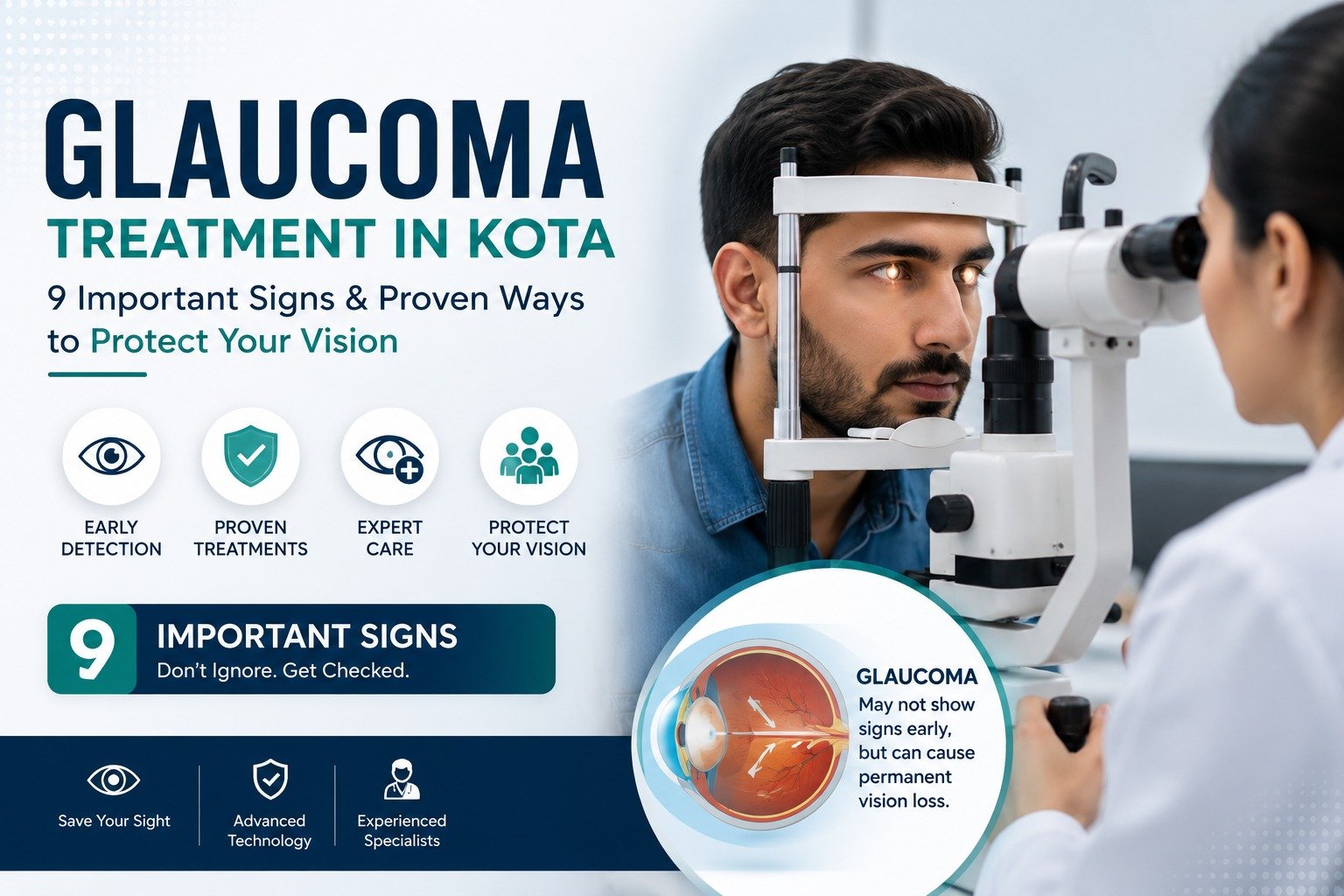
Glaucoma Treatment in Kota: 9 Important Signs & Proven Ways to Protect Your Vision
Glaucoma is a group of eye diseases that can damage the optic nerve and cause permanent vision loss if it is not detected and managed appropriately. One of the biggest challenges with glaucoma is that it may develop slowly without noticeable symptoms in its early stages.
If you are searching for glaucoma treatment in Kota, understanding the warning signs, risk factors, diagnostic tests and available treatment options can help you take the right step at the right time.
The National Eye Institute explains that glaucoma often has no early symptoms, which is why comprehensive eye examinations are important for detecting the disease.
What Is Glaucoma?
Glaucoma is a group of eye conditions that can damage the optic nerve, which carries visual information from the eye to the brain.
In many types of glaucoma, increased eye pressure is an important risk factor. However, glaucoma can also occur in people whose eye pressure is within a typical range.
This is why simply checking eye pressure is not enough to diagnose or rule out glaucoma. A comprehensive eye examination may be required.
9 Important Signs and Facts About Glaucoma
1. Glaucoma May Have No Early Symptoms
This is one of the most important things to understand about glaucoma.
In its early stages, glaucoma often does not cause noticeable symptoms. Vision loss can develop gradually, particularly affecting peripheral or side vision.
Because the changes may happen slowly, a person may not realise that their vision is being affected.
Regular eye examinations can therefore be important, especially for people who have risk factors for glaucoma.
2. Peripheral Vision Can Be Affected
As glaucoma progresses, vision loss may initially affect the sides of your visual field.
You may eventually notice:
- Difficulty seeing objects from the side
- Frequently bumping into objects
- Difficulty navigating unfamiliar places
- Problems noticing people or objects outside your central vision
Without appropriate treatment, glaucoma can progress to more significant vision loss.
3. High Eye Pressure Does Not Always Mean Glaucoma
Eye pressure, also called intraocular pressure (IOP), is an important factor in glaucoma evaluation.
However, having higher-than-usual eye pressure does not automatically mean that a person has glaucoma.
Similarly, some people can develop glaucoma even when their eye pressure is not elevated.
The National Eye Institute notes that the level of pressure that is normal can vary between individuals, which is why glaucoma assessment should consider more than one measurement.
4. Family History Can Increase Your Risk
Glaucoma can run in families.
If a close family member has glaucoma, tell your ophthalmologist during your eye examination.
Other factors may also increase the risk of developing glaucoma. Your eye specialist can assess your individual risk and recommend an appropriate examination schedule.
5. A Glaucoma Test Is More Than an Eye-Pressure Check
If you are considering glaucoma treatment in Kota, the first step is generally an appropriate eye examination rather than choosing treatment based only on eye pressure.
Depending on your condition, your ophthalmologist may perform or recommend tests such as:
- Visual acuity testing
- Eye pressure measurement
- Dilated eye examination
- Visual field testing
- Optic nerve evaluation
- Other specialised investigations when required
A comprehensive dilated eye examination can help doctors evaluate the optic nerve and look for signs of glaucoma. Visual field testing can assess side vision.
6. Glaucoma Treatment Can Help Slow Further Vision Loss
Glaucoma-related damage that has already occurred cannot simply be reversed, but treatment can help slow or control further damage.
Treatment is generally aimed at controlling factors such as eye pressure and protecting the optic nerve.
Depending on the type and severity of glaucoma, treatment may include:
- Prescription eye drops
- Laser treatment
- Surgery
The appropriate treatment depends on the individual patient’s diagnosis and eye health.
7. Glaucoma Eye Drops Need Consistency
Prescription eye drops are commonly used to lower eye pressure in glaucoma.
They need to be used exactly as prescribed by your ophthalmologist.
Stopping medication because your eyes feel normal can be risky because glaucoma may progress without obvious symptoms.
The National Eye Institute notes that glaucoma medicines can help prevent further damage, but they do not reverse existing vision loss.
If you experience side effects or have difficulty using your eye drops regularly, discuss this with your eye specialist instead of stopping treatment on your own.
8. Laser Treatment May Be an Option for Some Patients
Laser treatment can be used for certain types of glaucoma.
For example, laser trabeculoplasty can be used in some patients with open-angle glaucoma to help improve fluid drainage and lower eye pressure.
Laser treatment is not appropriate for every patient.
Your ophthalmologist will determine whether it is suitable based on your glaucoma type, eye anatomy, pressure and overall treatment plan.
9. Sudden Eye Pain and Blurred Vision Need Urgent Attention
Most glaucoma develops gradually, but some forms can cause sudden symptoms.
Sudden:
- Severe eye pain
- Redness of the eye
- Blurred vision
- Nausea or vomiting
can be associated with acute angle-closure glaucoma and require urgent medical evaluation.
Do not wait for a routine appointment if these symptoms occur suddenly. Seek urgent medical attention.
Types of Glaucoma
There are several types of glaucoma.
Open-Angle Glaucoma
This is a common form of glaucoma and can progress gradually without noticeable early symptoms.
Angle-Closure Glaucoma
This can sometimes develop suddenly and may cause severe eye pain, redness, blurred vision and nausea. Acute angle-closure glaucoma is an emergency.
Normal-Tension Glaucoma
Glaucoma can also occur in people whose measured eye pressure is not elevated.
Secondary Glaucoma
Glaucoma can sometimes develop as a result of another eye condition, injury, medication or medical condition.
Because different types of glaucoma require different approaches, accurate diagnosis is important.
How Is Glaucoma Diagnosed?
A glaucoma evaluation may involve several components.
Eye Pressure Measurement
This measures the pressure inside the eye.
However, eye pressure alone cannot confirm or exclude glaucoma.
Visual Field Test
A visual field test checks how well you can see objects outside your central vision.
This is particularly important because glaucoma can affect peripheral vision.
Optic Nerve Examination
The optic nerve is carefully evaluated for signs of damage.
Dilated Eye Examination
Eye drops may be used to enlarge the pupil so the ophthalmologist can examine structures inside the eye.
Additional tests may be recommended depending on the patient’s condition.
Who Should Consider a Glaucoma Eye Check?
An eye examination may be especially important if you:
- Have a family history of glaucoma
- Are older
- Have previously been told that your eye pressure is high
- Have experienced unexplained changes in vision
- Have certain medical or eye conditions associated with glaucoma
- Have previously been diagnosed with glaucoma
Your ophthalmologist can determine how frequently you need follow-up examinations based on your individual risk.
Glaucoma Treatment in Kota: Why Regular Follow-Up Matters
If you have already been diagnosed with glaucoma, treatment is not necessarily a one-time process.
Your ophthalmologist may need to monitor:
- Eye pressure
- Optic nerve health
- Visual field
- Treatment response
- Medication tolerance
- Disease progression
Regular follow-up allows your doctor to determine whether the current treatment is controlling the disease adequately.
If your treatment needs to change, your ophthalmologist can discuss alternatives such as different medicines, laser treatment or surgery where appropriate.
- National Eye Institute – Glaucoma
- National Eye Institute – Glaucoma and Eye Pressure
- National Eye Institute – Glaucoma Medicines
- National Eye Institute – Laser Treatment for Glaucoma
Can Glaucoma Be Cured?
Currently, glaucoma-related vision loss cannot simply be reversed.
However, appropriate treatment can help control the condition and slow further damage.
This makes early detection and ongoing management extremely important.
The goal of glaucoma treatment is to protect the vision you still have and reduce the risk of further optic-nerve damage.
Glaucoma Treatment in Kota by Dr. Ankur Gupta
If you are looking for glaucoma treatment in Kota, a detailed eye examination is an important starting point.
Dr. Ankur Gupta at Eye and Vision Centre provides ophthalmic evaluation and treatment planning for patients with glaucoma and other eye conditions.
A personalised assessment can help determine:
- Whether glaucoma is present
- Your current eye pressure
- Whether the optic nerve shows signs of damage
- Whether visual field testing is required
- Which treatment approach may be appropriate
- How frequently follow-up should be scheduled
Treatment decisions should always be based on an individual eye examination rather than symptoms alone.
Frequently Asked Questions About Glaucoma
What is glaucoma?
Glaucoma is a group of eye diseases that can damage the optic nerve and lead to vision loss.
What are the early symptoms of glaucoma?
Glaucoma often has no noticeable symptoms in its early stages. Peripheral vision loss may develop gradually as the disease progresses.
Is high eye pressure the same as glaucoma?
No. High eye pressure increases the risk of glaucoma, but not everyone with high eye pressure develops glaucoma. Glaucoma can also occur with normal eye pressure.
Can glaucoma cause blindness?
Untreated glaucoma can cause progressive vision loss and, in advanced cases, blindness. Early diagnosis and appropriate treatment can help slow further damage.
What is the most common treatment for glaucoma?
Prescription eye drops are commonly used. Depending on the type and severity of glaucoma, doctors may also recommend laser treatment or surgery.
Can glaucoma damage be reversed?
Vision loss caused by glaucoma cannot generally be reversed. Treatment focuses on slowing or preventing further damage.
When should I seek urgent help?
Sudden severe eye pain, red eye, blurred vision and nausea can occur with acute angle-closure glaucoma and require urgent medical attention.
How often should I get my eyes checked for glaucoma?
The appropriate interval depends on your age, risk factors and eye health. Your ophthalmologist can recommend a suitable examination schedule.
Conclusion
Glaucoma can develop silently, which makes regular eye examinations particularly important.
If you have a family history of glaucoma, high eye pressure or changes in your peripheral vision, speak with an ophthalmologist about appropriate testing.
If you are searching for glaucoma treatment in Kota, a comprehensive evaluation can help identify the condition, assess the health of the optic nerve and determine an appropriate treatment plan.
Protecting your vision starts with early detection and consistent eye care.